
Festival Planning · For vendors
Load-In, Setup, and Weather: A Vendor Field Guide for Outdoor Events
Plan festival and market load-in, tent weights, packing, and a rain plan so outdoor event day is setup, not improvisation.
Outdoor Days Are Won on Friday Night
Introduction
The sale starts when the tent is up, weighted, and dry enough to plug in a reader. Vendors who lose Saturday morning to a missing 40-pound weight, a dead battery, or a load-in window they treated as a suggestion spend the peak hours catching up.
This is a field guide for markets, festivals, and street events: how load-in actually works, what to pack, and how to treat rain and wind as a plan, not a surprise. Indoor mall shows still benefit from the packing list. The weather section is for grass, parking lots, and waterfronts.
Why Load-In Is a Timed Operation
Organizers stagger arrivals so one gate does not host forty trucks. You get a window, a route, and a rule that the vehicle leaves before you dress the booth. Typical outdoor load-in is 1 to 3 hours before open. A first-time 10x10 with weights and product can take 90 minutes; vendors with a system often hit 45 to 60.
Packets include the map, check-in gate, vehicle size limits, and how long you may occupy the unloading lane (sometimes about 25 minutes). Unload completely, move the vehicle to vendor parking, then set the tent. Doing it in the other order blocks the lane and makes you the problem.
Rain-or-shine is the default at many markets. Fees stay paid if you no-show for drizzle. Severe weather cancellations are the organizer's call. Your job is to arrive ready for wet and wind, then leave if they close the site.
Key Pieces of an Outdoor Setup
Tent, Weights, and Footprint
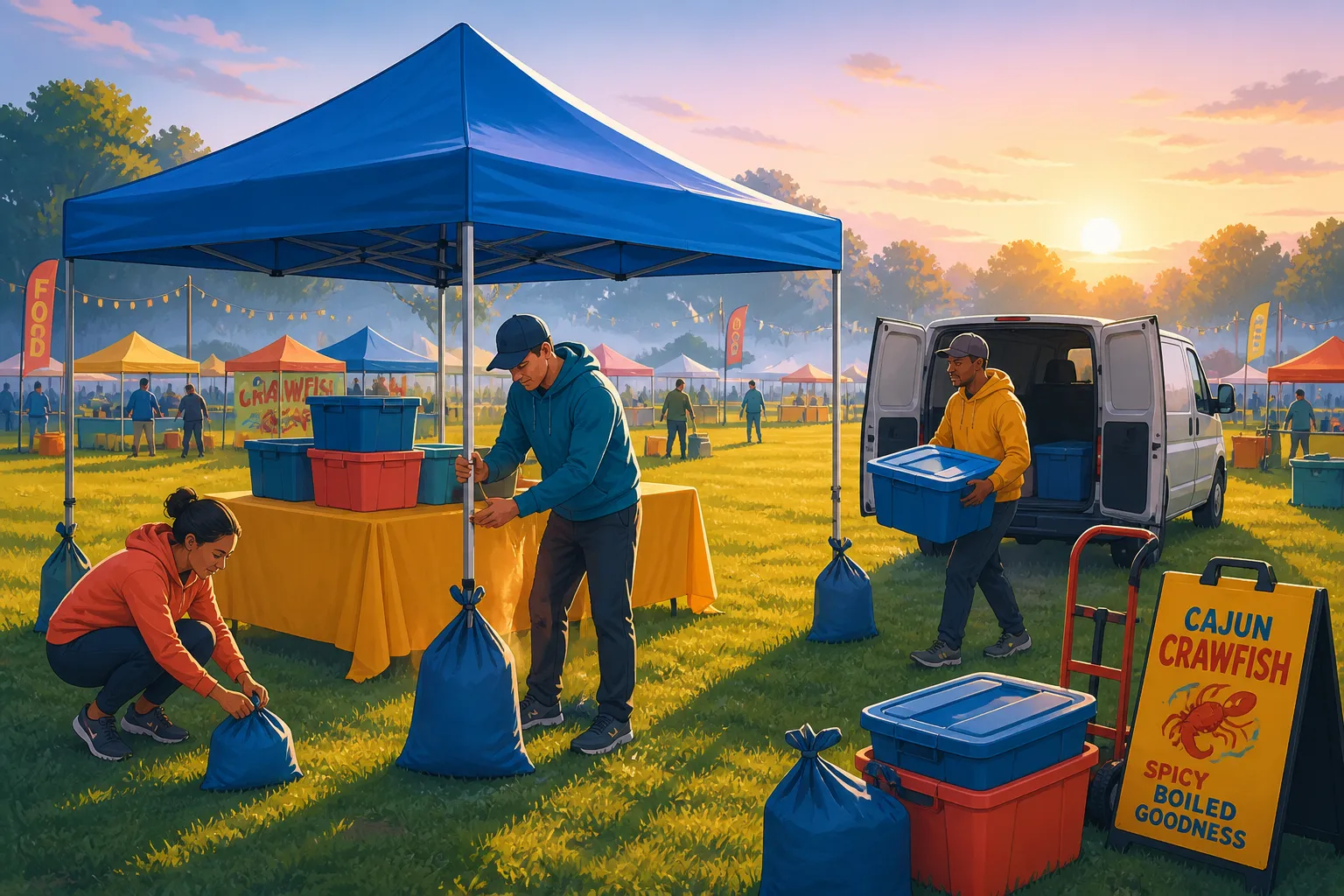
Standard space is 10x10. Walls and product must stay inside it. Weights are not optional on hard ground: 40 pounds per leg is a common minimum; 75 to 100 per leg when wind is in the forecast. Bags made for canopy legs beat loose bricks in the aisle. Stakes may be banned on pavement and on some lawns.
Wind, not water, knocks tents over. Sidewalls on the weather side stop blowing rain. Pool noodles or similar on the roof frame keep water from pooling. Clear shower-curtain fronts let people see in while the weather stays out.
Packing for the Day You Actually Have
Craft packing lists put tent and weights first, then tables, then product in lidded bins, then a rain kit (tarps, contractor bags, towels), then spare clothes and a power bank for the reader. Food adds ice, handwash, and a plan for grease. Label bins for setup order, not storage at home.
Practice the 10x10 at home once. Take a photo of a layout that worked. That photo is faster than reinventing the booth in a wet parking lot.
6 Steps From Driveway to Open
- Read the packet the night before. Window, gate, booth number, vehicle length, quiet-generator rules. Put the coordinator number in your phone.
- Arrive at the start of your window. Late means you hand-carry from distant parking.
- Unload, move the vehicle, then build. Tent and weights before product. Product in bins until the roof is up.
- Run the weather kit if the forecast earned it. Sidewalls, extra weight, bagged paper goods, reader in a dry box. Decide go vs skip 1 to 2 days out for serious wind, not 5 days out when the forecast is still a rumor.
- Be sellable 15 minutes before open. Card reader charged, prices out, aisle clear. A beautiful booth that is still hanging banners at 10:05 loses the first wave.
- Tear down in reverse after close. Product and tent down before the vehicle returns. Early teardown is how you lose the invite. Details live in the contract.
Questions Vendors Ask About Event Day
- Can I leave a van behind the tent, or is that a fire lane?
- What if my window overlaps a friend's and we share a helper?
- Do they cancel for lightning, or only for a city order?
- Are water-filled weights enough, or do they want sand or steel?
- If I sell out, do I still have to stay until close? (Many markets say yes.)
Tips for Success
Weight the Tent Like It Matters
Unweighted canopies injure people and end seasons. If the event requires 40 lb per leg, bring 40 lb per leg, not gym plates that slide off in a gust.
Keep a Dry Reader and a Cash Backup
Wet days kill phones and printers. A power bank in a bag and a small cash float are part of the weather kit, not extras.
Debrief Before You Unpack at Home
Note what you missed (another sidewall clip, a longer dolly). Update the packing list the same night. That list is how load-in gets shorter all summer.
Setup Is the First Product
Attendees never see the Friday-night pack. They see whether you look open and safe at 10 a.m. Treat load-in as part of the craft.
FestKit event maps are the same plans organizers send in the packet. Use them to find the booth and the gate before you idle in the wrong line. For the next date on the calendar, keep your vendor profile ready so the application is not another Saturday-night scramble.
Vending this season? Publish your profile on FestKit so organizers can find you, then browse events that are taking applications. See vendor profiles.