
Vendor Management · For vendors
How to Request (and Evaluate) Your Festival Booth Location
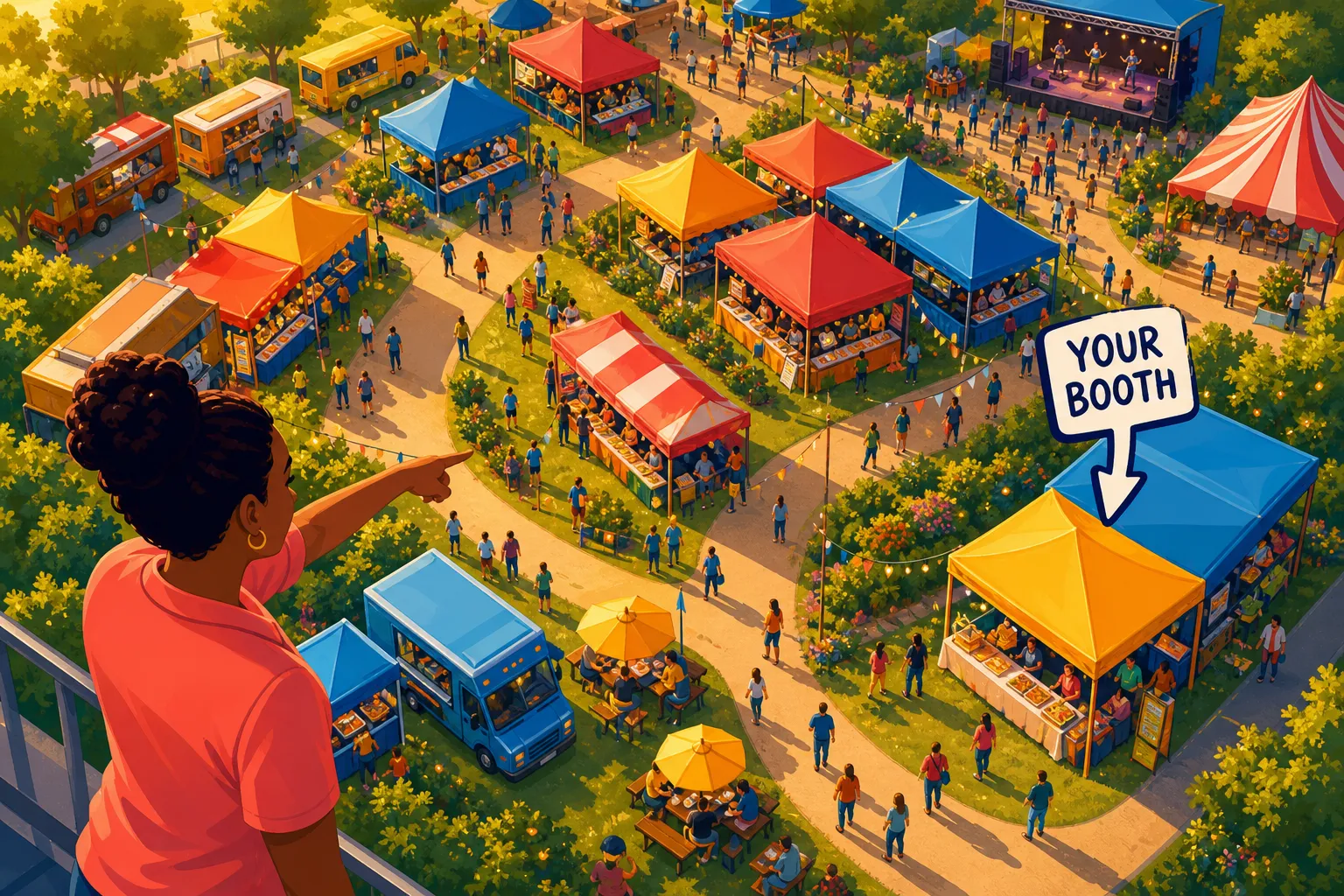
Ask for a better festival or market booth using the site map: foot traffic, corners, power, shade, and the dead zones you should decline.
The Map Is Part of Your Revenue
Introduction
Two booths, same product, same fee. One sits on the path between the main stage and the restrooms. One sits in a cul-de-sac behind the generators. Placement will not fix a product nobody wants, but it will decide whether a good product gets seen.
Organizers assign space under constraints you cannot see from Instagram: power drops, fire lanes, ADA routes, and who applied first. You can still ask with a reason. This guide covers how to read a public site map, what to request, and what to do with a weak assignment.
Why Location Is a Vendor Problem, Not Only an Organizer One
Foot traffic concentrates at entries, food clusters, and paths between program. Industry placement writing (including FestKit's organizer guide) treats those corridors as premium because dwell time and impulse spend are higher there. Corners and endcaps add a second open side; that is why they often cost more.
Not every "busy" spot sells. Right on the entrance, people are still arriving and may not stop. Directly on a speaker stack, you cannot talk. Next to a popular booth, your line may block theirs or you may share a crowd that already decided. Dead zones are predictable: far corners that require backtracking, the wrong side of a stage during a headliner, and rows that face a fence.
Your job is to know what your booth needs (power, shade, queue space, a quieter pitch) and to say that in the language of the map, not "somewhere good."
Key Things to Look for on the Map
Paths, Anchors, and Corners
Trace how an attendee walks from gate to stage to food to exit. Spots slightly inside that flow often beat the literal first booth. True corners (two aisles) catch people who pause to choose a direction. Perimeter corners can be quieter. Ask which kind you are paying for if there is an upcharge.
Power, Shade, Grade, and Wind
A fridge is not a fairy light. Confirm the drop on the map or in the packet. Afternoon sun on a west-facing front will cook chocolate and the person running the reader. Low spots collect rain. Wind alleys between buildings eat unweighted tents. These are location issues, not personality issues.
Neighbors and Category Spread
Organizers often spread similar food so one taco line does not kill three others. If you are placed next to two near-duplicates, ask whether a gap exists in another zone. If you sell kids' items, near the playground is a concrete request. If you need conversation (custom work, tastings), ask away from the PA.
6 Steps to Request a Spot Without Sounding Entitled
- Get the map early. If none exists yet, ask when it will. Interactive maps beat a photo of a Sharpie printout because you can see labels and amenities.
- State constraints first. "I need 20 amps" or "I need space for a 16-foot truck" is easier to honor than "a really visible booth."
- Give one preferred zone and one backup. "Along the path from Gate A to the beer garden, or the east food cluster" gives them a box to work in.
- Tie the ask to the attendee. "Hot sauce next to food" or "quiet enough to hear custom orders" is a partner sentence. "I want more money than booth 12" is not.
- Ask what is still open. Returning vendors and sponsors often hold corners. Knowing the remaining inventory keeps the conversation honest.
- Once assigned, walk it (or zoom it) and decide. If the spot is a known dead end and the fee was premium, ask to move or for a partial adjustment before you load in. After stakes are in, moves are rare.
Questions Vendors Ask About Placement
- Is this a corner fee for a true two-aisle corner or for the end of a row?
- Which way does the tent face relative to afternoon sun?
- Where do lines form for the booth next to me?
- Can I put a sandwich board in the aisle, or is that a fire-lane violation?
- If I am behind the stage, what is the schedule when that lawn is empty?
Tips for Success
Apply Early If Placement Is First-Come
Some events assign as applications clear. Others wait until the mix is set. If the listing says rolling placement, speed after a complete application is a location strategy.
Design for the Spot You Got
A mid-row booth can still pull with height, lighting, and a clear front 3 feet. FestivalNet's veteran advice: a slightly interior flow spot often beats the entrance. Work the assignment you have on Saturday; debrief on Monday.
Use Sunday Morning
If the event is multi-day, walk the grounds when it is quiet. Note where people actually move. Send that note with your post-event thank-you if you want a better pin next year. That is how returning vendors get first look at corners.
Ask With a Map, Not a Vibe
Organizers hear "good booth" all week. They can act on power, queue space, and a named path. Read the map, ask once, clearly, and then sell where you land.
FestKit events publish the site plan vendors use to make this request. When you want organizers to see your booth photos before they place you, keep a current vendor profile.
Vending this season? Publish your profile on FestKit so organizers can find you, then browse events that are taking applications. See vendor profiles.